

How do pollinating insects cope with mast seeding cycles in rowan? – a new publication
Rowan (Sorbus aucuparia) is a species that exhibits so-called mast years. This phenomenon, widespread among perennial plants, involves highly variable fruit production between years combined with synchronized reproduction among individuals. It is considered a strategy that reduces seed losses caused by seed predators through alternating periods of "predator satiation" (during mast years) and "predator starvation". This raises an important question, however: could a mechanism that effectively weakens the pressure of seed consumers simultaneously have negative effects on mutualistic interactions, such as plant–pollinator relationships?
A recent paper published in Oikos examined the relationship between temporal flowering intensity and pollination efficiency in a Babia Góra population of rowan. The authors – a team of ecologists led by Prof. Magdalena Żywiec – collected four years of data on flower and fruit production, as well as on the species composition of insects visiting tree crowns. The analyses did not confirm the existence of a "pollinator satiation" effect under conditions of high flowering intensity. On the contrary, pollination efficiency increased with flower density and remained consistently high (around 80%). This pattern was most likely driven by the flexibility of plant–pollinator interactions, expressed through shifts in pollinator community composition depending on flowering intensity — from communities dominated by Bombus (bumblebees) during abundant flowering to communities dominated by Andrena (mining bees) and Lasioglossum (sweat bees) during years of low flower production.
The study demonstrates that in animal-pollinated species, plant–pollinator interactions do not necessarily constrain the evolution of reproductive strategies based on mast seeding cycles.
Original article:
Szymkowiak J., Bogdziewicz M., Celary W., Piechnik Ł., Ledwoń M., Szarek-Łukaszewska G., Seget B., Kondrat K., Zubek K., Żywiec M. 2025. Dynamic pollinator networks maintain pollination efficiency during mast flowering in an insect-pollinated tree. Oikos 2026: e11682. DOI
The research was funded by the European Union (ERC, ForestFuture, 101039066) and by the statutory funds of the W. Szafer Institute of Botany, Polish Academy of Sciences.
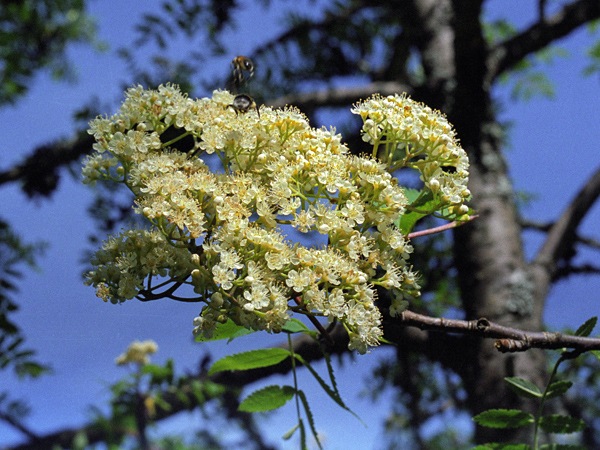
Rowan inflorescence.
Photo: Magdalena Żywiec
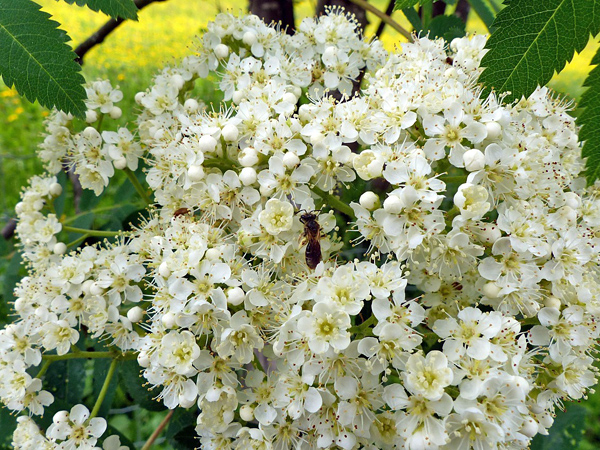
Rowan inflorescence.
Photo: pixabay.com


