

Have humans influenced the range of European bladdernut (Staphylea pinnata) in Europe?
Knowledge about the factors influencing the spatial and temporal dynamics of plant species makes it possible to assess current rates and directions of range changes and, consequently, to predict biodiversity trends. Among the factors determining species distributions, anthropogenic influences constitute an important group. Through long-term and diverse human activities leading to the transformation of natural habitats into semi-natural ones, species associated with xerothermic grasslands and open deciduous forests, among others, expanded their disjunct ranges. Some species were unintentionally transported to new areas by migrating human communities, whereas others were introduced deliberately. One example of the latter is the European bladdernut (Staphylea pinnata L.) – a shrub commonly planted near human settlements because of its practical, ornamental, and cultural value. Although the hypothesis that the northern range of bladdernut in Central Europe was shaped by human activity (through digging up plants from natural localities and transporting them to newly settled areas) appears plausible, until recently it had not been scientifically tested.
A paper presenting the results of integrated taxonomic and phylogeographic studies on European bladdernut has just been published in Vegetation History and Archeobotany. An international team of researchers, including scientists from our Institute – led by Dr. Łukasz Piechnik, together with Dr. Elżbieta Cieślak and Prof. Magdalena Żywiec – used archaeobotanical and ethnobotanical data, as well as genetic markers and morphometric analyses based on population material collected across Europe, the Caucasus, and the Anatolian Peninsula, covering the species’ entire Eurasian range. The aim was to test the hypothesis that the present-day distribution of European bladdernut was shaped partly by anthropogenic factors.
The researchers demonstrated that the Caucasus and the Anatolian Peninsula constituted a Tertiary refugium for European bladdernut. In Europe, refugia located on the Apennine and Balkan Peninsulas served as independent sources of the species’ natural postglacial recolonization northwards. These migration routes, represented by distinct genetic lineages, met at the northern margins of the present-day range – from eastern France through Bavaria and Lower Silesia in Poland to northern Podolia in Ukraine – forming a so-called "contact zone". Importantly, it is precisely in these areas that the distribution of haplotypes partly deviates from natural patterns. It was also observed that localities of European bladdernut in these regions are often associated with areas rich in remains of human settlements dating from the Bronze Age to the Early Middle Ages. Despite this population pattern, humans were not a major factor shaping the overall distribution of European bladdernut in Europe, as indicated by the genetic structure of this relict species. Instead, the distribution was most likely determined by natural habitat and climatic conditions formed during the last glaciation. Human activity, however, may have contributed to the persistence of the species within local community systems.
Original article:
Piechnik Ł., Łabiszak B., Cieślak E., Szczepański S., Kurek P., Novikov A., Rosati L., Dönmez A.A., Dering M., Wójcik T., et al. 2025. Genetic and biometric patterns of rangewide divergence of iconic, Neogene relic broadleaved shrub species Staphylea pinnata L. – post-glacial expansion and human impact. Vegetation History and Archaeobotany 34: 399–413. DOI
The article is the result of research conducted within the NCN Preludium project (2021/41/N/NZ9/02430) entitled "Native or foreign? Phylogeography of European bladdernut Staphylea pinnata L. in Central Europe", led by Dr. Łukasz Piechnik.
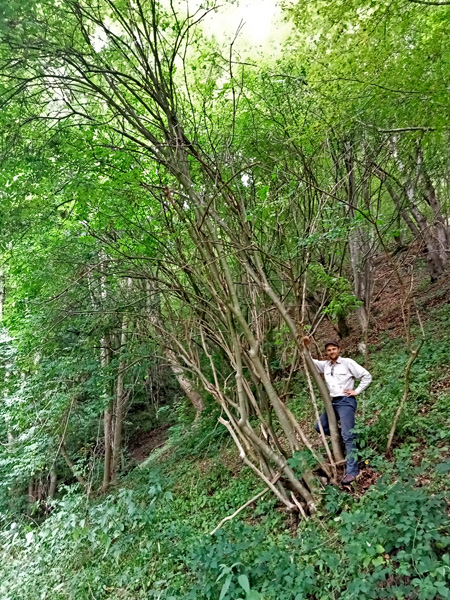
Large European bladdernut shrub growing on a steep slope of the Danube valley near Passau, Germany.
Photo: Łukasz Piechnik.
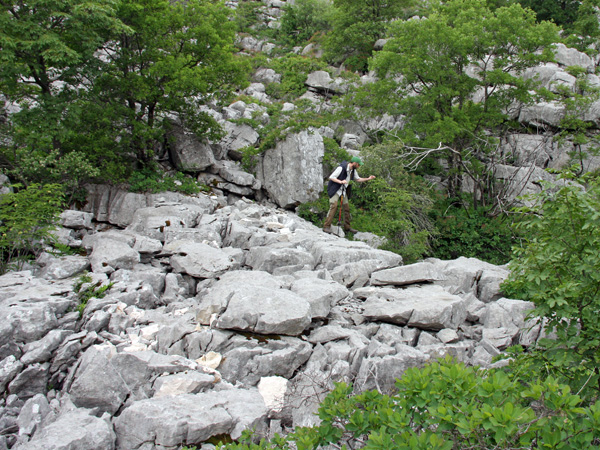
Collection of European bladdernut samples near the village of Bokovo, Montenegro.
Photo: Łukasz Wilk.
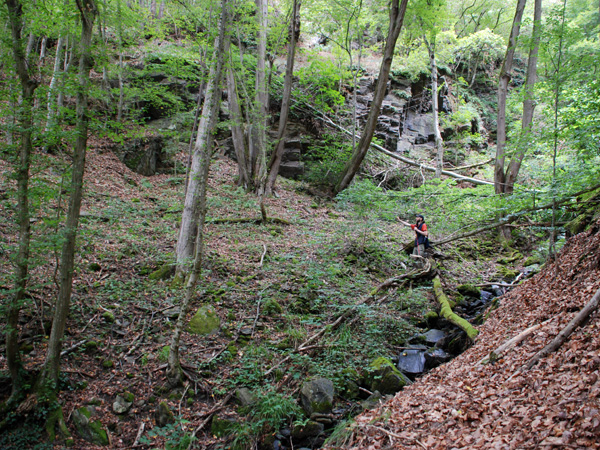
Collection of European bladdernut samples on the slopes of the Danube valley near Passau, Germany.
Photo: Tomasz Wójcik.
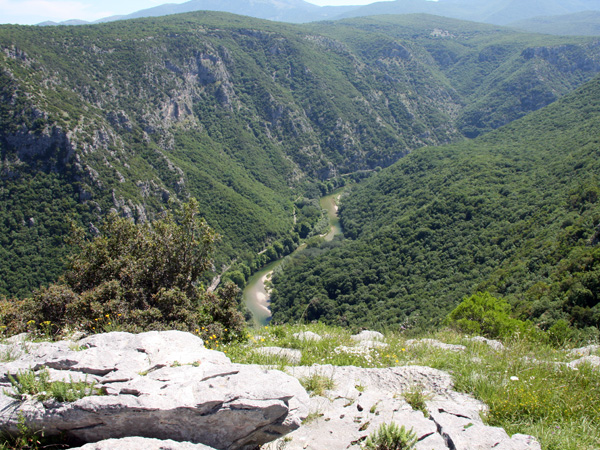
Forests in the Nestos River canyon, a habitat of European bladdernut – one of the two Greek localities of the species. Rhodope Mountains, Greece.
Photo: Łukasz Piechnik.
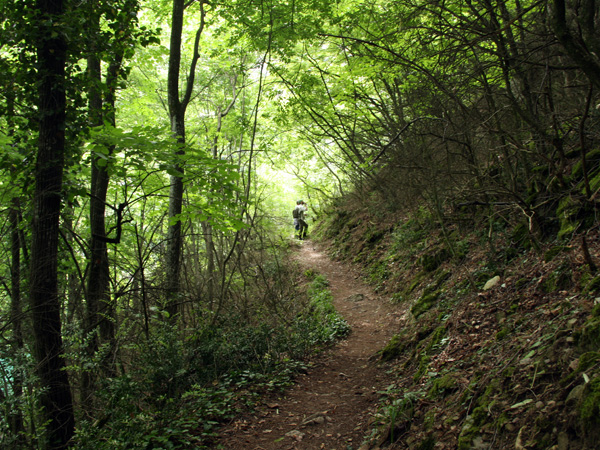
Search for one of the four Macedonian localities of European bladdernut – Matka Canyon on the Treska River, North Macedonia.
Photo: Łukasz Wilk.
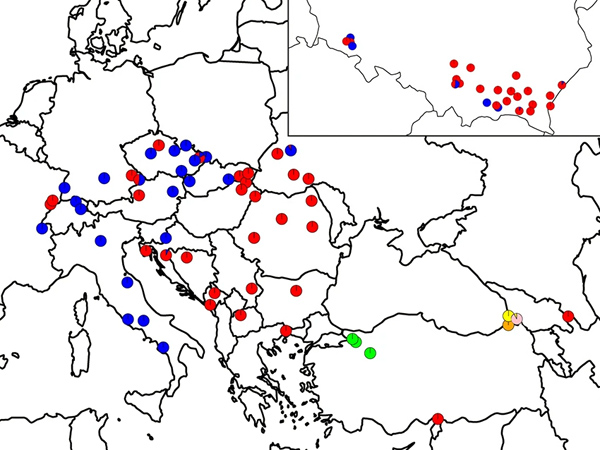
Geographic distribution of all six haplotypes of European bladdernut across the species’ geographic range.
Photo: IB PAS.


